The essentials
- At the northern end it is close to fresh, which is why it behaves like a lake and freezes over.
- The Bothnian Bay ices over almost every year, and in cold winters much of the Baltic follows.
- Level ice regularly reaches that in a normal winter, and ridging piles it far deeper.
- Wind and current push the sheet about, which is why a broken channel closes again.
Why most seas do not freeze here
Salt water is stubborn about freezing. Dissolved salt lowers the freezing point to around minus two, and, more importantly, it changes how the water behaves as it cools: instead of the coldest water staying on top, it sinks, so the whole column has to be chilled before a surface can form.
That is why the Norwegian coast at the same latitude stays open all winter despite being considerably further north than Kemi. Full-strength ocean water, kept moving by the Atlantic, simply does not get the chance.
The Gulf of Bothnia is a different kind of sea, and the difference is the reason this tour exists.
There is a second, less obvious effect. Because the coldest fresh water rises rather than sinks, a nearly fresh sea can put a lid on itself while the water a few metres down is still comparatively warm. A salt sea has to be cooled all the way through before anything can happen on top, which is a vastly larger quantity of heat to remove.
A sea that is nearly a lake
The Baltic is the largest brackish body of water in the world. It is fed by an enormous catchment of rivers and connected to the North Sea only through the narrow, shallow Danish straits, so the salt exchange is poor and the fresh water input is huge.
Salinity falls the further north you go. By the time you reach the Bothnian Bay at the top, the water is close to fresh, and it behaves accordingly: densest at four degrees, coldest water rising to the surface, and a freezing point close to zero.
So it freezes, as a lake freezes, and it does so almost every winter across the whole northern bay.
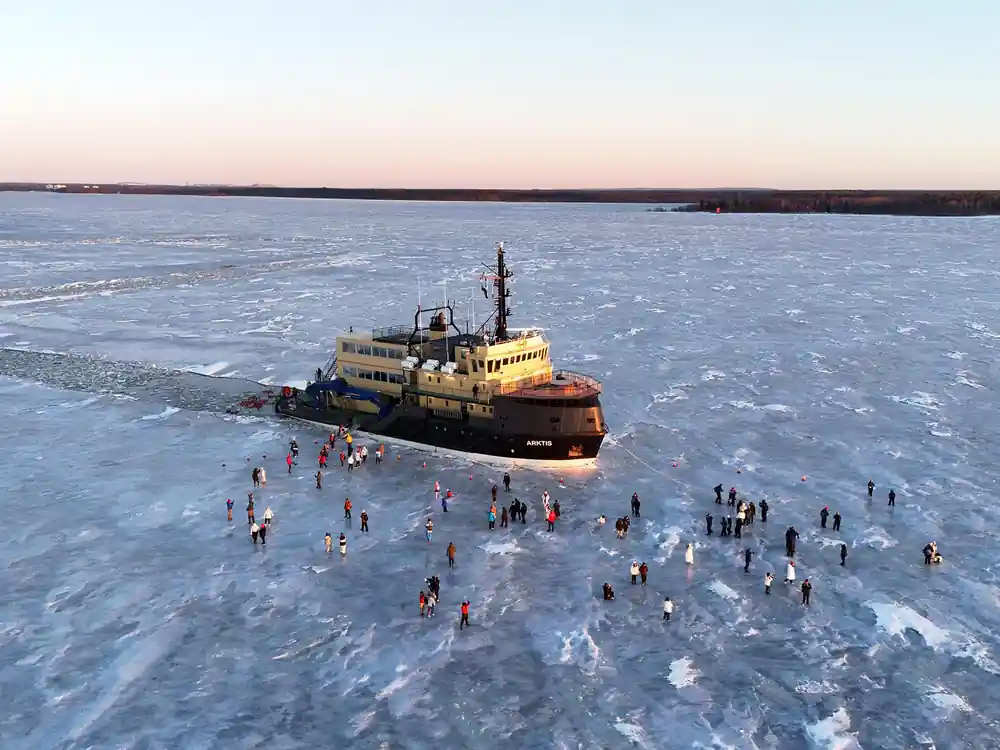
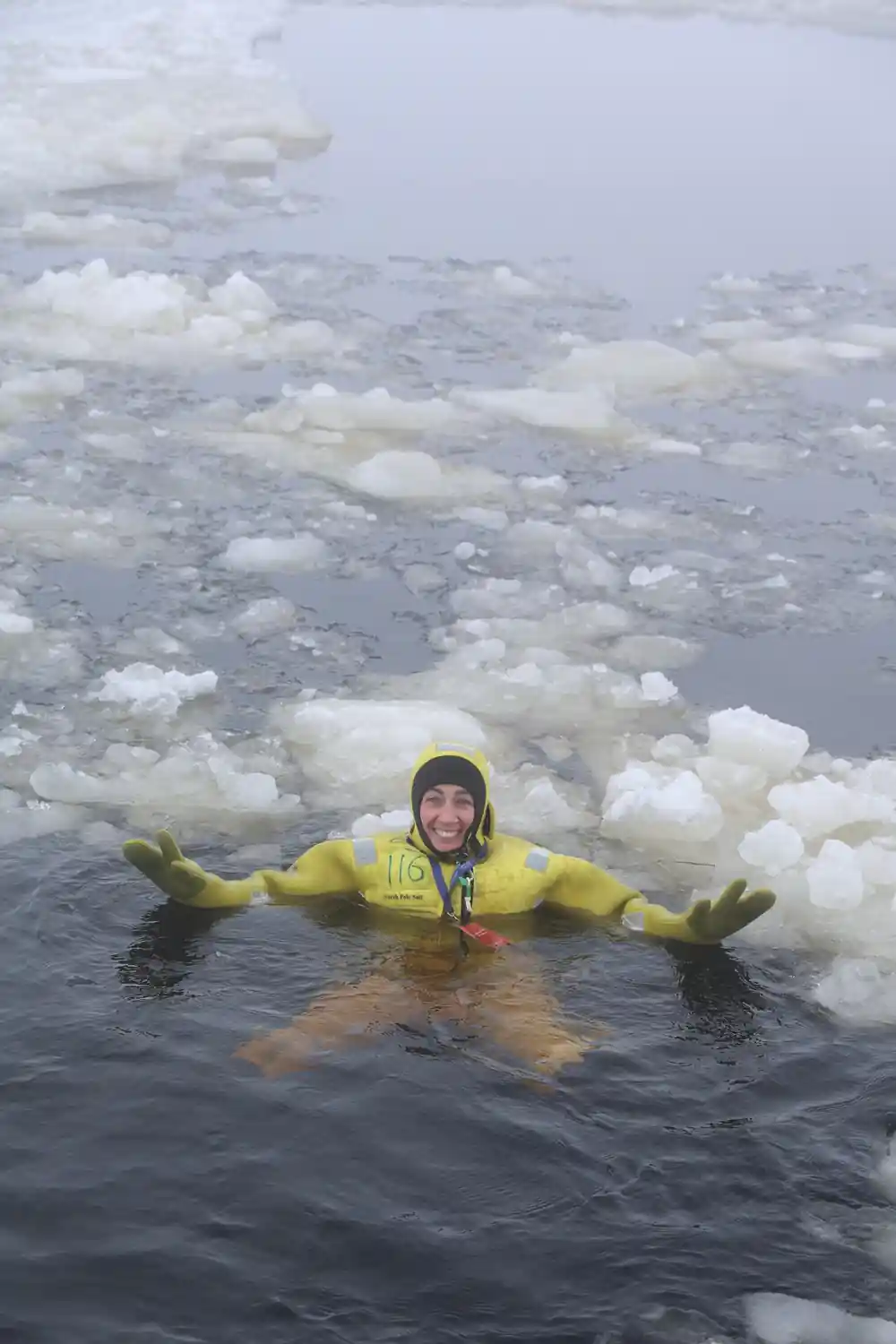
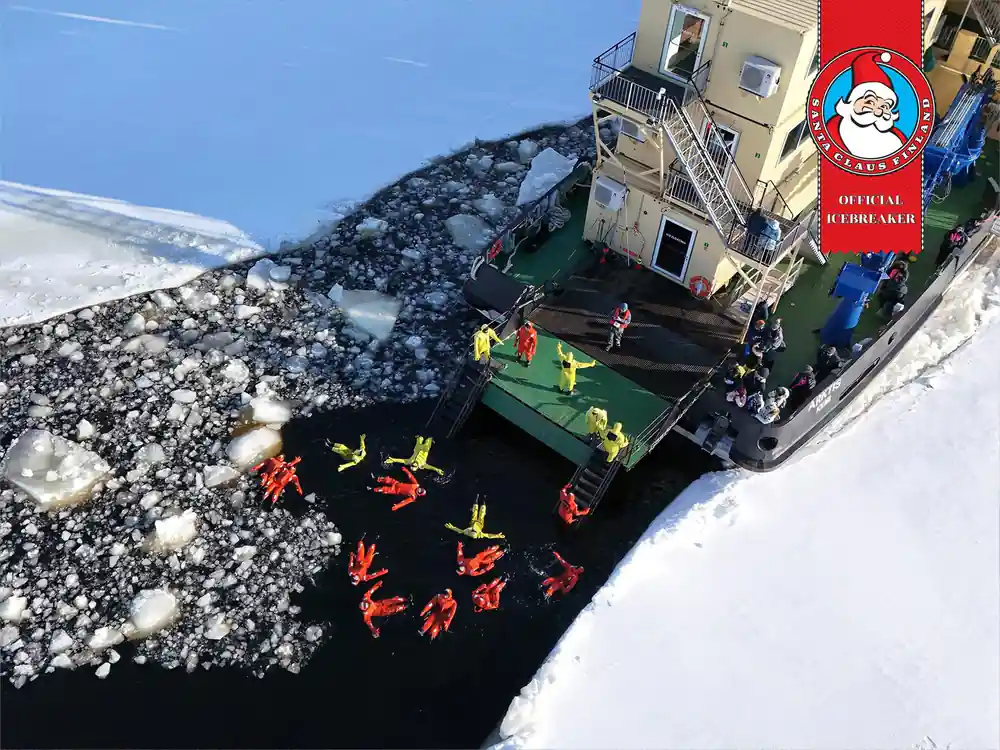
Broken plates alongside the hull, black water between them
How the ice forms
It begins as a slush of loose crystals, thickens into a flexible skin, and then, if the water is calm enough, sets into a solid sheet. On open water where waves keep working the surface, the result is different: rounded plates form with raised rims where they knock against one another, which is one of the more striking things to see from a ship.
Once a sheet exists it grows downward, because the water below is losing heat through it. Growth slows as the ice thickens, since the ice itself insulates what is underneath.
Snow on top accelerates nothing and slows everything: it is an excellent insulator, so a heavy snow year can produce thinner ice than a clear cold one.
The plate formation has a name, pancake ice, and it is one of the few pieces of technical vocabulary that describes exactly what it looks like. From a deck you can watch the plates jostle and grind against one another, wearing their edges into raised rims, and eventually freeze together into a continuous sheet that carries the pattern like a memory.
How thick, and how variable
Level ice in the Bothnian Bay commonly reaches half a metre and beyond in a normal winter, and that is only part of the story. Where sheets are driven against each other by wind, they break and pile, forming ridges that extend both above and far below the surface.
It is the ridges that matter to shipping. A vessel can handle level ice steadily and be stopped completely by a ridge, because what is visible above the surface is a fraction of what is below it.
Thickness varies enormously between winters, and the people who work here talk about the ice year the way farmers talk about the harvest.
0.5 m+
Level ice thickness the Bothnian Bay commonly reaches in a normal winter. Where wind drives sheets together, ridges extend far deeper than that below the surface.
Why a channel does not stay open
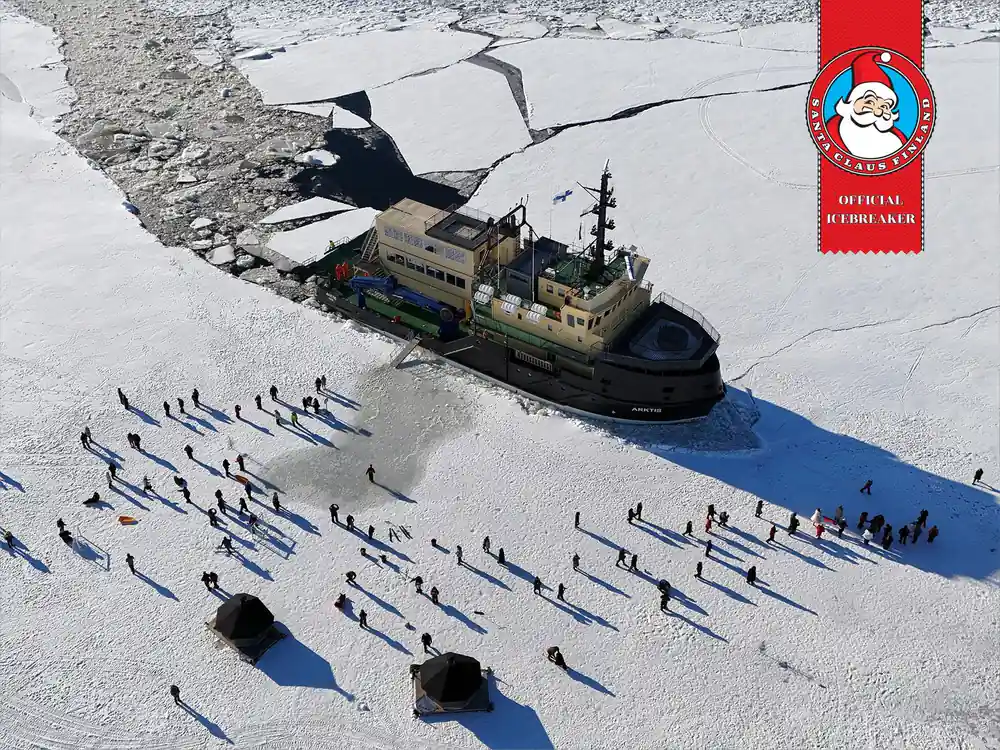
The sheet is not fixed. It drifts with wind and current, sometimes several kilometres a day, and a channel cut through moving ice closes behind the ship that made it.
That is why icebreaking is a continuous service rather than a job that gets finished. Ports on this coast need to be broken out repeatedly through the winter, and vessels are escorted rather than simply given a route.
It also means the ice you sail through on any given day is genuinely that day’s ice, rearranged since the last cruise.
This is also why the channel behind the ship is not a permanent feature of the sea and why photographs of it are worth taking at the time. Within a day or two of a cruise the lane you sailed down may have closed, refrozen, or drifted several kilometres from where it was cut, and the next ship will make a new one somewhere else entirely.
Walking on it
Ice thickness in Finland is measured rather than guessed, with published load tables, and the people who decide whether a group can step onto a frozen sea are doing so from data rather than from confidence.
On a cruise, walking on the ice is offered when conditions allow and not when they do not. That conditionality is a sign of a well-run operation rather than a disappointing one.
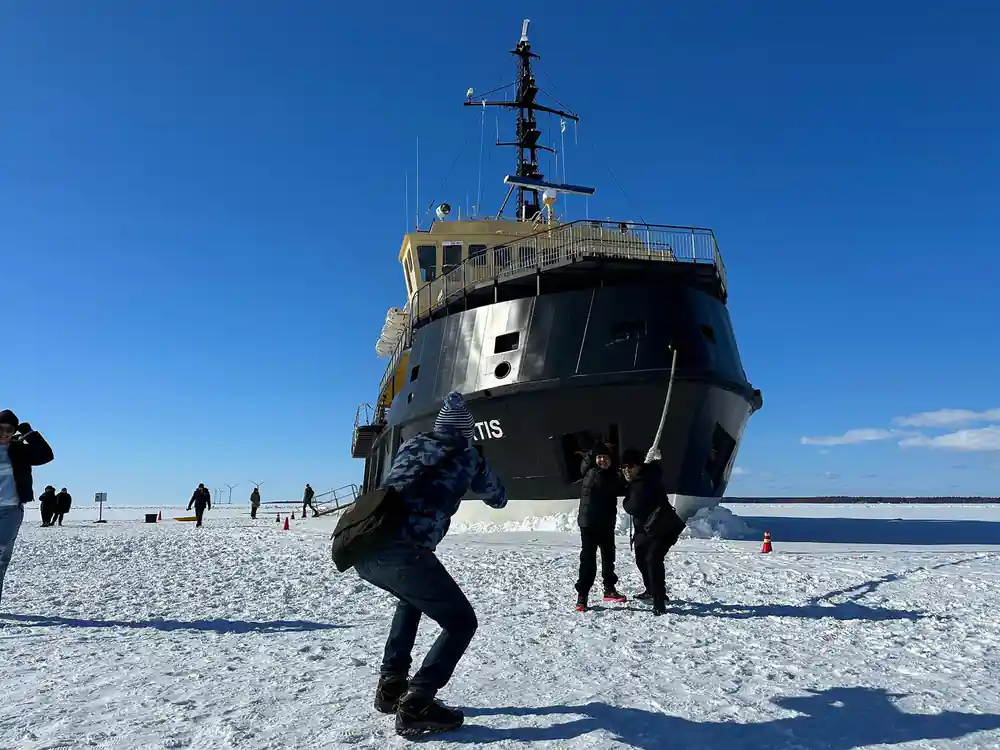
When it does happen it is one of the strangest sensations available to a visitor: standing on a surface that is unambiguously a sea, with a horizon in every direction and a metre of water somewhere beneath your boots.
A sea that is changing
The maximum extent of Baltic ice varies hugely from winter to winter, and the long-term trend has been towards less of it. Mild winters now produce years in which only the northern bay freezes properly.
That is worth knowing rather than worrying about for a booking: the Bothnian Bay, at the top, is the last part to stop freezing and the most reliable place on the sea to find ice.
It also means the icebreaking fleet and everything built around it, including this cruise, is tied to something that is not guaranteed indefinitely.
A sea that freezes because it is barely salt
from US$473Reserve now & pay later